

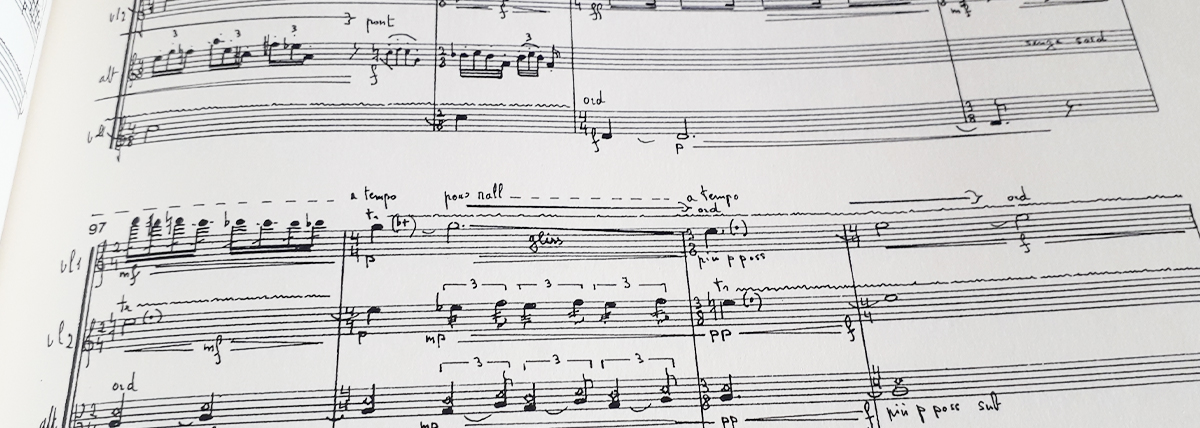
Patron of the arts and sciences, Anne Gruner Schlumberger has supported contemporary composers, such as Roger Blanchard (1919-2011), Erich Itor Kahn (1905-1956), and Gérard Grisey (1946-1998).
In order to continue to support artistic creation, a composition residency prize has been created at the Fondation des Treilles. It is dedicated to the production of a musical work for concert, stage or audiovisual purpose, for which the candidate has already a commissioning contract signed with either a public or private musical structure.
This prize consists of a three-month residency at the Domaine des Treilles (Var), with a monthly prize of €2,650, paid according to the length of the resident’s stay.
Candidates
Applications are open to all nationalities from May 1st to October 1st.
Only professional candidates whose music has already been recorded or performed may apply.
The project for which the candidate submits his/her application must be either under a contract of engagement or commissioned by a public or private institution (Opera House, Orchestra, AV producer etc…). The commissioning contract must identify both parties, the musical work, the commission fee as well as the date of completion of the work. You cannot apply if the date of completion is prior to the date of residency.
Applications are received via an online form including a CV, the list of works already composed and a presentation of the project. At the same time, candidates must send to prix.composition@fondationdestreilles.com :
– at least two scores (in PDF format only) and the corresponding recordings or links to these recordings; if these are not available, the sound files (in mp3 or mp4 format only) ;
– the commissioning contract.
All applications are evaluated by the jury, which selects a laureate.
To know when to send your application, please refer to the calls for applications.
The laureate
The prize winner will be hosted at the Domaine des Treilles for a total period of three months, although the stay may be fragmented. The first trip to and from the Fondation des Treilles is refunded. Meals and accommodation are also provided by the Foundation. This allows the laureate to devote himself/herself fully to his/her creative project.
The laureate will stay in the Maison de Moussu which includes a bedroom, a kitchen, a bathroom and the composition studio.
This composition studio is equipped with an upright piano, a keyboard, a sound card and speakers.
The winner must bring his/her own computer.
He/she undertakes to respect the rules and regulations of the music composition residency.
At the end of the residency, the prizewinner is invited to give a copy of his or her score to the Foundation’s music library.

Winners over the years
FLORENT CARON DARRAS
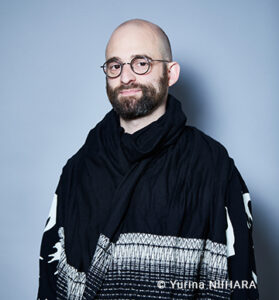 Born in Japan in 1986, Florent Caron Darras composes music inspired by the relationships between humans, the environment and technology. Exploring, in particular, the phenomena of micro-variation within repetition, his work forges links between the worlds of soundscapes (bioacoustics, field recording), traditional oral music, and spectral, minimalist and electronic music.
Trained at the Paris Conservatoire (CNSMDP) and Ircam, and holding a PhD from the SACRe research-creation programme (PSL University), he collaborates with numerous French and international ensembles, including the Ensemble intercontemporain, 2e2m, Court-Circuit, TM+, Ars Nova, Cairn, Multilatérale, United Instruments of Lucilin (Luxembourg), the Muromachi Ensemble (Tokyo) and the Castalian Quartet (London), as well as with conductors Matthias Pintscher, David Reiland, Léo Warynski and Jean Deroyer.
His works have been performed at the Philharmonie de Paris, the Maison de la Radio, IRCAM, the Philharmonie Luxembourg, the Tokyo Bunka Kaikan, Suginami Hall in Tokyo, the National Hall in Taipei and the Centre Pompidou × West Bund Museum in Shanghai, as well as at the Présences, ManiFeste and Mixtur festivals.
Composer-in-residence at the Cité musicale-Metz and the Metz Grand Est National Orchestra from 2022 to 2024, he was awarded the André Caplet Prize by the Académie des Beaux-Arts in 2023. His first solo album, Territoires, was released in 2026. He teaches sound art at the École Nationale Supérieure d’Arts de Paris-Cergy (ENSAPC).
His project
Tisserand(e)s (weavers), for large orchestra and grand organ, stems from a desire to listen that arose from visual sensations, particularly those experienced whilst practising photography: those of embroidery, ornamentation, and the intertwined curves of plant veins and textiles. From this sensory intuition, two figures have emerged: Ada Lovelace, who draws parallels between the operations of the Analytical Engine and the patterns woven by the Jacquard loom (which forms a historical link between computing and weaving), and Reiko Sudō, whose textile creations combine materials derived from living organisms with experimental technologies. Code and fibre, structure and flexibility: music can become a mesh, like a micro-varied ornamental weave, which is also a network of relationships between the musicians – these other weavers – but also between the orchestra and the audience. He seeks to develop an organic soundscape in which references to the worlds of electronics, plants and textiles persist.
“ The relationship between the orchestra and the organ plays a dual role in this research. Firstly, because I approach the organ as an electronic instrument, with its stops conceivable as additive synthesis. Its spatiality also endows it with the qualities of ‘mixed’ music without loudspeakers. Secondly, because this keyboard instrument with its sustained sound can act as the taut thread upon which string and wind instruments weave their patterns. I envisage an architecture of more or less flexible lines of sound, an immersive acoustic mesh into which the listener could plunge and lose themselves. Furthermore, unambiguous, striking, homorhythmic elements will assert themselves as fundamental introductory and structural markers.
To take this further, I asked myself how to conceive of a single instrument (a question commonly posed in the context of the orchestra, here extended to the orchestra/organ relationship). My answer is to approach the organ first as an extension of the orchestra, then to reverse this, making the orchestra a spatial extension of the organ: let the orchestra become, as it were, a sound installation. The performers will thus be able to play various rudimentary wind instruments: slide flutes, harmonicas, kazoos, recorder-style flutes and whistles. An interweaving of pipes. And, following in the footsteps of Reiko Sudō, the biodegradability of fabrics, the imaginary biodegradability of sound that fades away into silence.”
BENJAMIN ATTAHIR
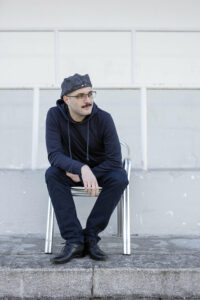 Born in Toulouse in 1989, Benjamin Attahir began by learning the violin and then, very early on, developed a passion for composition. His teachers include Édith Canat de Chizy, Marc-André Dalbavie, Gérard Pesson, and Pierre Boulez. Winner of numerous awards (Ernst von Siemens Prize, USA IHC Bloomington, UNESCO International Rostrum of Composers, SACEM/SACD distinctions, Académie des Beaux-Arts), he was nominated for the Victoires de la Musique Classique (Classical music awards) in 2019, 2021, and 2023.
His works are performed by various ensembles and orchestras (Bayerischer Runfunk Orchester, Staatskapelle Berlin, Seattle Symphony, Orchestre Philharmonique de Radio France, Orchestre National de France, Orchestre du Capitole de Toulouse, Helsinki Philharmonic, Netherlands Philharmonic, Orchestre de Chambre de Lausanne, Ensemble Intercontemporain, etc.). Composer-in-residence for various orchestras and festivals (Lille National Orchestra, Gulbenkian Orchestra in Lisbon, Aix-en-Provence Festival, etc.) and a former resident of the Villa Medici, he has composed five operas, the premieres of which he also conducts. The stage is the backbone of his musical writing, which, like his heritage, draws its inspiration from a blend of East and West. He regularly collaborates with renowned artists (D. Barenboim, R. Capuçon, B. Chamayou, J-G. Queyras, J-Y. Thibaudet). As a conductor, he has led the Royal Orchestra of La Monnaie in Brussels, the Lille National Orchestra, the Lausanne Chamber Orchestra, the Conservatoire Laureates Orchestra, as well as ensembles such as Les Illuminations, DAI, and Aenea. His works are published by Durand Salabert Eschig.
His project
« Love is Louder is a concerto project for clarinet, fans, and symphony orchestra. Yes, fans, you read that right. Beyond their integration as modulated sound sources throughout the piece, these objects—incongruous, you might say—will create an olfactory dramaturgy, opening a new space of resonance for the soundscapes through which the soloist will guide us.
The basis of my musical composition is the score that the artist Erich Berghammer created using resins, flowers, and plant essences; each atmosphere corresponds to a movement of the concerto, and these musical moments will in turn be woven together by gradual transitions, much like the slow change of air filled with scents.
A true sensory kaleidoscope, each part – at least for the design work – will be affiliated with a master color (red, orange, yellow, green, turquoise, indigo, violet) which will allow me to develop a new musical syntax enabling me to put molecular and spectral phenomena into sound ».
VICENTE ATRIA
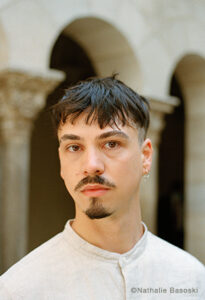 Vicente Atria, born in 1992, is a Chilean composer and drummer. Described as “virtuosic”, “revelatory” (The New York Times) and “ecstatic,” (The Guardian), his music riffs on a wide range of idioms, from microtonal renaissance dances to Korean sanjo, creating playful, vibrant sonic worlds.
A Deutscher Jazzpreis recipient, Vicente’s work has been commissioned or performed by the Sun Ra Arkestra, JACK Quartet, Wet Ink Ensemble, Ensemble Proton Bern, Yarn/Wire, International Contemporary Ensemble, and Longleash. He has been featured in venues and festivals including the Moers Festival (Germany), Skanu Mezs (Latvia), MATA Festival (NY), Wigmore Hall (UK), The Shed, Roulette Intermedium, The Jazz Gallery, and The Stone (all located in New York).
He is nominated for the 2024 Busoni Komponistpreis, and has won a Wet Ink Ensemble AIR residence (2023), a MacDowell Fellowship (2023), an ASCAP Herb Alpert Young Jazz Composer Award (2022), an ACF Create award (2021), The Shed Open Call commission (2019), two Chilean Ministry of Culture Fondo de la Música grants (2022 & 2020), and an ASCAP Morton Gould Young Composer Award (finalist, 2016). He holds a Doctorate of Musical Arts in Composition from Columbia University.
His project
During his residency, Vicente Atria will create a 25-minute composition commissioned by Ensemble Proton Bern. This new work will delve into the imagined intersections of Transylvanian and Swiss folk traditions, European Renaissance practices, and early colonial music from the Americas, specifically inspired by the cultural richness of the Viceroyalty of Peru.
Drawing on his fascination with “imaginary folk traditions”, Vicente will explore how these musical worlds might have interacted in an alternative historical reality. With instrumentation that includes flute, clarinet, oboe (doubling on musset), bassoon (doubling on contraforte), Baroque harp, spinet, stroh-violin, and Baroque cello, he will weave together historical and folk timbres to create an immersive soundscape that transcends time and place. Through this collaboration, Vicente aims to offer audiences a speculative sound-world that connects distant musical histories and reimagines their potential for shared expression.
HAROLD NOBEN

Harold Noben is a Belgian composer based in Brussels. After obtaining a graduate degree in piano from the Royal Conservatory of Music in Liège, his home town, he gradually devoted himself to composition. His first opera, À l’extrême bord du monde, a chamber opera about the tragic ending of Stefan Zweig and his second wife Lotte, was premiered at La Monnaie, Brussels, in October 2020. This opera was the culmination of his composition residency at the Chapelle Musicale Reine Elisabeth under the supervision of the Belgian composer Benoît Mernier.
Following the warm reception given to this opera, La Monnaie commissioned him a brand new symphonic work, Beyond (a concerto for orchestra), premiered at Bozar, Brussels, in September 2020, under the baton of Alain Altinoglu.
He has been commissioned by various ensembles and orchestras, including the Chapelle Musicale Reine Elisabeth, La Monnaie, the Orchestre Philharmonique Royal de Liège, the Ô-Celli cello octet, the Musiques Nouvelles ensemble and others.
He also collaborated with the twelve cellists of the Berliner Philharmoniker on their latest album dedicated to Piazzolla (Hora Cero, Sony, 2016).
Several of his works are recorded on albums and are available on his website and standard online music platforms.
La Monnaie has commissioned him to write a new opera, to be premiered in Brussels in April 2025.
His string quartet Quartet from the Portuguese, based on the poetess Elisabeth Barrett Browning’s Sonnets from the Portuguese, was awarded the Prix Marcel Hastir by the Académie Royale de Belgique in November 2022.
His project
During his residency at the Fondation des Treilles, Harold Noben will focus all his work on producing his new opera for voice, orchestra and small choir. This project is an adaptation of Madame Bovary, Gustave Flaubert’s masterpiece, with a libretto written by the author and stage director Michaël De Cock, who also adapted it for the Flemish National Theatre, as well as making a movie directed by Jaco Van Dormael and filmed when all venues were closed during the pandemic. This film won the “Menzione Speciale, Il Cavallo Di Leonardo Da Vinci” award at the Milan Film Festival (MIFF).
Far from an opera that will simply illustrate Flaubert’s work in a chronological manner, it will explore the inner self of Emma’s character through, somehow, an inner monologue, when on the verge of death, she recalls all the events in her life that have brought her to this tragic ending. The point of view changes from that of the novel, the aim here being to give flesh to this woman and her most intimate experiences through song and music.
In addition to the inner monologue that we hear through Flaubert’s sentences – retracing both landmarks in Emma’s story and her feelings about her desires, lies and contempt – the orchestra will offer us, beyond words, a glimpse of Emma’s inner life, shedding light on what cannot be translated into verbal language.
The story arc of this inner monologue remains a delicate and daunting challenge, since it involves giving expression to Emma Bovary in the 21st century in a society radically different from that of Flaubert.
The musical language of this opera will therefore be based on universal expressive means that touch on the complex and intimate feelings of the human being, while using at the same time composition techniques that are part of the music of our time.
TOMÁS BORDALEJO
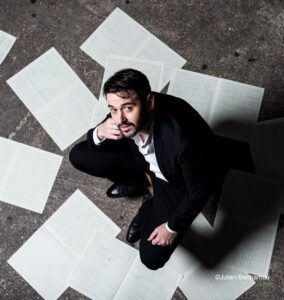 Winner of Sacem’s « Francis et Mica Salabert » prize, Tomás Bordalejo is also laureate of the Banque Populaire Foundation and in 2019 he won the prize of the Tribune of Composers of Argentina (TRINAC).
He arrived in Paris in 2005 to pursue higher education, after three years of jazz studies at the Institute of Contemporary Music in his native city. He joined the conservatory of Gennevilliers, then the CRR of Paris, the Pôle Supérieur de Création Boulogne-Billancourt and the University of Paris IV where he obtained a National Professional musical Diploma and a Musicology licence.
His encounter with the composer Bernard Cavanna at the Académie de Villecroze was decisive for his career. Peter Eötvös, Pascal Dusapin, Edith Canat de Chizy, Yan Maresz, Philippe Hersant, and Philippe Manoury also encouraged him to consolidate his own language marked by an original aesthetic.
His work is part of a genuine compositional research marked by a constant dialogue with the arts, architecture, urbanism and philosophy.
Each piece bears witness to a staging of the sound material and a new reflection on the modes of play.
Tomás Bordalejo has collaborated with the main French ensembles (2e2m, Court-cicuit, l’Itinéraire, TM+) as well as with internationally renowned soloists (Gérard Caussé, Noëmi Schindler, Vincent Lhermet, Michel Portal, David Kadouch, Paul Meyer). His music has been performed in prestigious venues such as the Philharmonie de Paris and the Colon Theatre in Buenos Aires.
His project
His project will focus on an instrument with deeply Mediterranean roots and a history marked by migration: the mandolin.
Between learned music and traditional music, the mandolin carries a rich history marked by migration and the Mediterranean cultural ensemble. Its hybrid characteristics, between lute, guitar and violin (G-D-A-E chord), make it the instrument of choice for the Florentine serenade of the 18th century as well as the Neapolitan song of the 19th century. In the 18th century, the mandolin was adopted by the French royalty and the best Italian mandolinists settled in Paris, thus marking a first migration.
At the end of the 19th and beginning of the 20th century, the mandolin travelled a second time in the suitcases of the French, Italians and Spaniards leaving their land for the Americas in search of a better future, taking with them the repertoire of southern Italy: that of the Neapolitan song, whose influence will be fundamental for the Argentinean Tango or the Brazilian Choro.
During his stay at the Fondation des Treilles he will work on a triptych around the mandolin:
– a piece for solo mandolin
– an installation piece for tactile tapestries, mandolin and electronic support
– a chamber opera in which the mandolin will play a central role.
Works created during the residency
Tomás Bordalejo, Trois façons de décrire le temps (three ways of describing the time), piece for mandolin commissioned by the association ‘Les pincées musicales’ (Argenteuil) and created at the Festival Vagues sonores of Miramas in April 2024. The score was published by Artchipel musical editions in 2024.
Harold Noben, Bovary (booklet made by Michael de Cock), opera commissioned by ‘La Monnaie’ in Brussels and created at the Brussels National Theatre in April 2025.
Vicente Atria, The Pilgrimage of Paracelsus, a work commissioned by Ensemble Proton Bern and premiered at the Dampfzentrale Bern in April 2026.